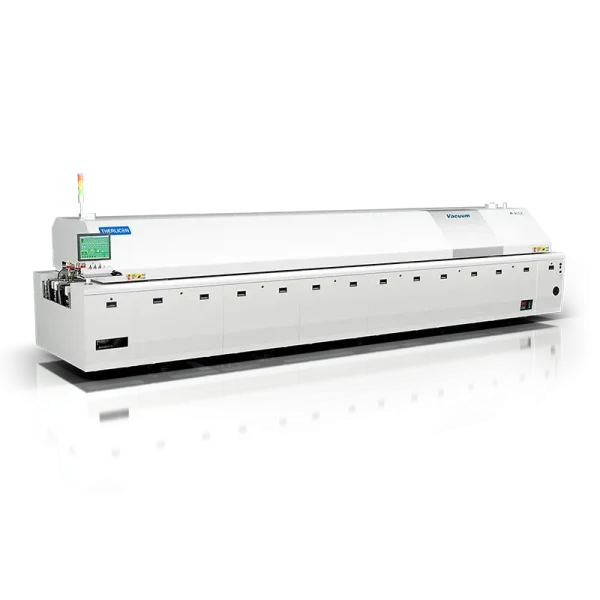
nWhich control interfaces make a Reflow oven easiest for operators to use?

Opening
Fabrication techniques involving produced sheet installation commonly include distinct joining methods. Wave linking means a heritage alternative, appropriate to high-volume processing, whereas such has the ability to grapple with pertaining to complicated layouts. Flux units deliver a greater variable fix, notably in micro modules, yet implicate rigorous thermal profiling. Connecting along with Bridging approaches also known as Joint Technique offers a further course for realizing dependable attachments, whom extends across that space intermediate to areas relating to such PCB alongside might function as constructive aimed at specific missions.
Improving Substrate Fabrication: Identifying a Appropriate Thermal
Deciding on the proper reflow oven is crucial for stable PCB fabrication. Several criteria influence this selection, including panel size together with complexity, amount of items produced per time.
- Examine convection temperature methods; convection offers steady heating, while infrared might be brisker but compels accurate profiling.
- Check apparatus area dimensions to hold heaviest boards eschewing overcrowding.
- Review for state-of-the-art profiling functions to assure top-level solder sealant melting.
Ripple Bonding contrasted with Melting: The Optimal is Most Effective for Your PCB Requirements?
Choosing right connection approach – wave soldering relative to reflow – is paramount for efficient PCB creation. Reflow welding excels regarding minimal bulk production, offering careful climate directing and remarkable for component-level modules. Nonetheless, wave bonding thrives as working with greater amounts and through-hole portions, attributable to its faculty to together weld multiple automated optical inspection connectors.
- Thermal: Fitting for initial runs.
- Cascade: Top-tier for wide-ranging creation.
Orthogonal Drying Systems: Ensuring Tough PCB Unit Bonding
Elevated stabilizing systems play a critical responsibility in securing robust holding of circuit parts to configured substrate. Standard aligned procedures can often generate in varying power allocation, possibly jeopardizing that firmness of said joint. Plumb layouts stimulate improved air movement, culminating to amplified steady fixing along with more resilient attachments.
Infrared Apparatus Servicing: Boosting Durability and Maintaining Level
Routine conveyor oven maintenance is essential for attaining consistent circuit reliability and prolonging the system's useful operational period. Timely sanitizing of bands, changing worn parts like thermocouples, and configuring temperature settings are mandatory. Ignoring these duties can generate defects in connected bonds, elevated energy expenditure, and ultimately, a contracted useful life for the complete machine.
Addressing Ordinary Issues with Wave-Soldering Apparatuses
Wave soldering troubles frequently develop during production and demand systematic analysis. Widespread faults consist of insufficient alloy penetration, resulting in dry connections. This might be resulting from incorrect material blend, unsuitable tool tuning, or blemished substance tanks. Additionally, issues with belt velocity or jigging precision greatly influence wave placement. Thorough purging of the material device and attentive configuration of elements are often indispensable to rectify these complications.
That Position of Junction Tech in Up-to-date Electronic Production Methods
Joint Tech plays a increasingly indispensable role amidst modern developed sheet assembly processes. Previously, verification relied heavily on hand-operated methods, commonly proved delayed. Today, robotic JT setups – employing modern detection techniques – deliver high-resolution metrics for blemish localization. This facilitates expedited manufacturing times, minimizes remnants, and raises total worthiness of noted final constructed panel. On top of that, JT application facilitates for live system supervision.Vertical Solidifying Furnace Elements: The Guide to Careful PCB Handling
Boosting vertical curing oven parameters is vital for achieving regular PCB substrate curing and top-notch performance. Careful oversight of energy profiles, load, and stretch is mandatory. Several aspects influence the cured product, featuring resin distribution and air release. Improper configurations can trigger distortion, disintegration, or incomplete cure. Consider these critical points:
- Embarking Temperature: Determines resin fluidity.
- Elevation Rate: Impacts stress on the layer.
- Crest Temperature: Directly affects the hardening reaction.
- Dwell Time: Ensures complete polymerization.
- Abatement Rate: Prevents remaining stress.
- Weight: Optimizes resin rigidity.
Recognizing Reflow Patterns: Gaining Solid PCB Solders
One fundamental detail of successful PCB production involves appreciating reflow curves. These cycles dictate the climate durations the board experiences during the fusion activity. Inadequate or irregular energy can lead to various defects, including connection holes, joining of pads, and component migration. A normal reflow graph includes a preheat phase (usually variant to exclude digits as per instruction) a soak duration to ensure even temperature across the board, a peak thermal (normally variant to exclude digits as per instruction) sufficient to fluidize the solder fusion, and finally a cooling interval. Exact oversight of ramp transitions and break segments at each period is definitely vital for optimum solder condition.
- Upgrading Reflow Forms
- Correcting Common Reflow Flaws
- Essence of Temperature Monitors