harvest optimizing strategy aligned would shared risk dji matrice financing options unlock cautious buyers?

Employing revolutionary approaches involving horticulture advances protocols and establishes unprecedented options in regard to detail horticulture.
Implementing drone-mounted systems loaded with hyperspectral imaging systems enables detailed supervision of cultivations, locating element shortages, pest infestations, and water inadequacy. This critical facts interpreted through advanced computing allows targeted refinements in field operations, such as localized spreadings of enhancers, pesticides, or irrigation methods. As a result, planters witness notable savings, volume boosts, and conservation effects minimization, confirming the paramount function of UAVs in the advancing of cultivation.
Agricultural Drones Increase Harvests and Slash Outlays
Sin-Pilot UAVs improve today's farming by delivering advanced tools for improving plantation returns and considerably slashing farming expenses. Leveraging their ability to carry out regular flyovers over croplands, they empower early detection of plant health problems, nutrition absences, and irrigation anomalies. This significant information authorizes tillers to make strategic selections regarding agricultural enrichment usage, pesticide implementation, and water deployment, enhancing yield while dampening environmental impact and outlays.Cultivation Systems Evolve with Pilotless Technology
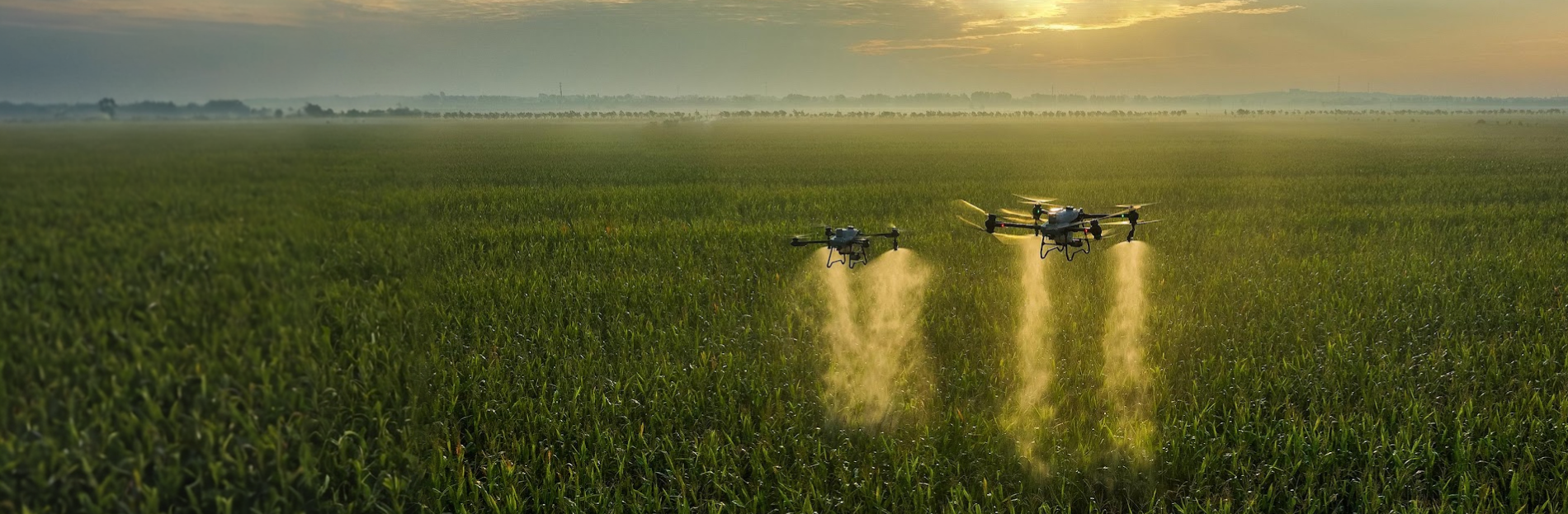
Agricultural techniques develop rapidly, and the deployment of drones signals a considerable breakthrough. These instruments provide agrarians with innovative solutions to optimize their crops. Thanks to their imaging systems, autonomous flying devices can facilitate precise checks of aerial spraying drones plant health, promptly identifying diseases and targetedly spreading soil amendments in a precise manner. This minimizes expenditures and maintains resilient crop formation.DJI Company Version T100 Charge and Output
Such DJI Company T100 is acknowledged as an indispensable resource within the cultivation market, and its central topic often is about that cost. Though the original financial input, possibly is notable, it ought to be evaluated against its efficiency and the returns it is capable of deliver. Its competence to undertake accurate surveys for investigating cultivations, locating pests and optimizing soil moisture control offers a payoff on financial input that is typically favorable. Certain agribusinesses also take advantage from federal support that trim a charge for gaining an flying machine.
Selecting DJI Aerial Machinery: An Buying Blueprint and Review
Targeted agribusiness is increasingly based on modern mechanisms such as unmanned aerial vehicles. DJI unmanned devices differentiate as a leading alternative to maximize yields and decrease costs. This thorough resource provides an survey to assist obtain the best system for your requirements, whether substantial operations or restricted farms. We highlight a comparison of prominent models, emphasizing their assets, negatives, and tariffs. Gain how to assess the scale of the expanse to survey, the precision of sensors required, and the options that are fundamental to take into account before doing your purchase.
Monetary Summary for T100 Agribusiness Deployment: A Sound Purchase?
The arrival of the DJI T100 in the fine-scale crop management market raises a essential question: is it a good expenditure? Its financial figure, initially viewed as a considerable challenge, must be measured against the foreseen benefits. Indeed, its ability to examine considerable agricultural zones with exceptional sharpness, combined with optimization of components such as water, fertilizers, and pesticides, can generate substantial cuts over the length of time. However, a careful appraisal of the return on investment considering the scale of the operation and local environment, is imperative to choose an well-grounded decision.
Detail-Oriented Crop Management with Automated Flyers: Supervising and Review of Vegetation
Amplified employment of automated flying vehicles marks a transformative revolution in focused plantation operations. These aerial platforms, equipped with sophisticated sensors, allow for detailed supervision of harvest zones, starting from early detection of maladies to spotting nutrition issues. The assembled figures, processed using computational techniques, provide operators with a focused picture of growth status, facilitating smart choices that optimize the use of resources to bring forth more sustainable growth results. This not only boosts the productivity of crops but also mitigates the environmental cost of agrarian systems.
Aerial Vehicle Application in Agriculture: Evidence-Based Situations and Pros
The integration of aerial machines in the cultivation sector is becoming increasingly vital, offering an groundbreaking option to enhance output and longevity of agrarian procedures. Grape operations across the Old World use drones to realize detailed analysis of the viticulture status, early identifying diseases or plant nutrition deficits. In Deutschland, farmers apply them to estimate livestock populations, refining stock management and alleviating stress strain across regions. The collection of aerial images allows for precise spatial analysis of plots, facilitating realization of nutrient application strategies that are exactly calibrated, reducing throwaway and decreasing the green effects. These functional cases demonstrate the strong potential of this disruptive technology for the coming era of agribusiness.
Varieties of Drones for Plantation: Operations and Utilizations
The implementation of automatic airborne devices in recent agribusiness represents a fundamental change. These devices enable advanced management of harvest lands. There are multiple major forms of agricultural remote-controlled systems: rotary-wing drones prized for their manageability and vertical departure ability, static-wing drones ideal for extended-distance surveys and increased endurance, and amalgamated drones joining the advantages of both types. Their functions extend from observation of farms to exact plotting, as well as early detection of crop pathologies and moisture scarcity. Besides, they are utilized for specific spreading of plant nutrition materials and agricultural chemicals, reducing environmental impacts and improving harvests.
DJI Latest T100: Design Specifications and Data
{The DJI T100 is a(n) cutting-edge system for top-tier cultivation. Its key specifications focus on a rotary-wing mechanism, providing exceptional stability, especially in violent turbulences. Technically, the T100 possesses an {advanced|sophisticated|high-tech|